Showing posts with label artists. Show all posts

Thursday, March 8, 2012

Farewell Slideshow...

-Still photographs of urban artwork provided by Monica Macellari

Thank you, Pilsen!!

--Monica Macellari, Katherine Hall, Amanda Boleman, and Irish Mae Silvestre

Monday, March 5, 2012

TPP: Some Final Thoughts And a Thank You

As my classmates Amanda and Monica have already said quite eloquently, a great deal was learned and accomplished over the past few weeks. We have had the pleasure of working with a terrific artist and his site. We have learned an unbelievable amount, not just about social media, network and producing content for online news, but about a vibrant, fun, and all-around cool community. So I won't belabor the points made by my classmates (good points all). Instead, I would like, on behalf of the Pilsen Project, to extend my sincerest thanks to Pilsen and its artists for welcoming us into their community, taking time to talk with us, and sharing with us your enthusiasm for what you do and the neighborhood you call home.

A project like this is only as successful--or indeed as interesting--as the subject matter allows it to be. As our statistics showed over the past four weeks (almost 2,000 unique views in under four weeks!) The Pilsen Project was quite successful, if we do say so ourselves. We couldn't have accomplished that without the Pilsen art community, who effectively made this project as colorful and fun as it was.

So thank you Miguel Cortez, Jeriah Hildwine, Saul Aguirre, Alvaro Sahagun, Rebecca Beachy, Kate Bowen and all the other artists who took the time to speak with us about art, about community, and the subtle (and not so subtle!) intersections between the two. We could not have done this without you.


Katherine H.

Friday, March 2, 2012

Art in Other Forms: Music (Part 2 of 2)


Part of Pilsen’s appeal to local, independent musicians is its sheer number of recording studios, stages, and other venues for meeting musicians, producing, and playing music. The community's openness to new sounds, and its tight-knit DIY vibe makes this the ideal place to meet and work with like-minded folks in the music industry. Below is a sampler of some of those places. Check out the map for more listings!

ApeTrax Recording Studios--Located on the corner of 18th and South Peoria, ApeTrax is a recording studio which caters to a wide variety of sounds. While their web page has not been updated recently, the images of their newly updated studio are impressive, as is their list of past clients. ApeTrax specializes in “providing artists with excellent quality audio in an affordable and relaxed environment.”

Mariachi Mexico Vivo—formed in 2005, this Pilsen-area group of eight gives a nod to the neighborhood’s Mexican roots. As their name suggests, Mariachi Mexico Vivo specializes in traditional mariachi music, an energetic and upbeat style native to Mexico. They have played for a number of events and at concerts, including a 2008 appearance with Gloria Trevi, a Mexican pop-rock musician, at the Congress Theater.

Miller Street Studios--Specializing in urban music and hip hop sound, Miller Street Studios heralds itself as offering the “highest quality recording capabilities for the lowest rates in Chicago.” They are active in social media, and their blog (managed by the owners and interns) is used not just to promote artists at the studio, but to discuss musical genre, aesthetics, and what makes "good" sound.

Click on the map below to see more studios, stores, and music venues!


Katherine H.

Tuesday, February 28, 2012

Artist Snapshot: Alvaro Sahagun (Part 2 of 2)

(interview with Sahugan continued.....)
 
3.) What do you appreciate about the Pilsen art community?
I love Pilsen and its art community. I enjoy its urban environment, the cultural richness in the environment it’s around. When I was a young boy I had a lot of family in the little village / Pilsen area. I would love to spend weekends there and be around the liveliness of the community. The murals and overall ambience for me as a child was very welcoming.  I love the abundance of art galleries and their Friday exhibits.  I love the art work that is displayed as well, it’s great community that fosters growth for young artist that are at the beginning of their careers. The freshness and “cool” (contemporary style) artwork is fascinating to me.
4.) What galleries has your work been featured at?
My artwork has been featured at Union Street Gallery, Visual Arts Gallery, Moraine Valley College Art Gallery and at the Governors State University Library.

5.) Any upcoming shows??
Yes! My artwork Naturalized Citizens was just accepted to a National exhibition at Union Street Gallery (http://www.unionstreetgallery.org/) by Juror Elizabeth Whiting curator for the Union League Club of Chicago. I was also invited to display my art at the same location for an exhibition in April of 2012 titled Threshold. Threshold will provide me with 13 feet of wall space where I may display my art, it’s intended to highlight beginning artist.  I will also be in a student exhibition in May 2012 where the judge will be Jeff Zimmerman, Chicago muralist artist. 
For more information about my artwork please visit.
Twitter: @lsahagun2

-Monica M.

Monday, February 27, 2012

Artist Snapshot: Alvaro Sahagun (Part 1 of 2)


Images courtesy of Alvaro Sahagun
1.) Full name and quick bio....has art always been a part of your life? How did you get started?
My name is Luis Alvaro Sahagun I was born in Guadalajara, Mexico and raised in the urban setting of Chicago Heights, Illinois.  Like most children drawing cartoons and creating imaginative superheroes was my coping mechanism to my childhood problems.  Art has always been a part of my life; it is my medication. My artwork is indicative of how I see the world and how I battle with the difficulties of life.
2.) What is your favorite medium and why?
I am currently in love with creating art with cardboard. By using an urban material and a contemporary process I create a merge between academia and street art.  The outcome challenges the audience to re-evaluate their preconceived notions of which materials are accepted as beautiful in art.

-Monica M.

Friday, February 24, 2012

Art in Schools Part 2 of 2

After years of pushing to improve their standardized test scores drastically reduced the time spent on art classes, elementary schools are once again trying to bring those subjects back up to strength. Unfortunately, the grim economy has made it difficult to find the funding to hire new instructors, create new spaces for art classrooms, or provide sufficient supplies.

This is where the art community has stepped in to fill the gap.

Local nonprofits, museums, and community centers are partnering with schools to provide in-school instruction and after-school programs that provide art education students would otherwise not be able to receive.

In Chicago, there is extra emphasis not just on the importance of teaching children about art, but ensuring that they all have access to it, regardless of age or socioeconomic status. Organizations like Prosarts Studio, Marwen, the South Chicago Art Center and Gallery 37 provide space, materials, and classes for children and youth at low or no cost.

One organization in particular has taken the mission of providing quality art education to youth too heart. 


A girl works on part of a mural | photo courtesy of Yollocalli
Yollocalli Arts Reach, a youth art initiative associated with the National Museum of Mexican Art, began in 1997 with the vision to provide “equal access to communal, artistic, and cultural resources” to area youth who might not otherwise be able to afford costly extra-curricular art classes.


Yollocalli does not just serve students who want to pursue a career in the arts, either.


“Most of our students just simply enjoy making and learning about art and do not have many opportunities to explore it on their own,” Vanessa Sanchez, Yollocalli’s program director, said in an email. Sanchez said that the students who came in to Yollocalli ended the program feeling confident about their abilities not just to create a work of art, but effectively communicate with each other about their work, art in history, and their future goals.


“Our young people are given the space to create art based on their own stories and lifestyles,” Sanchez added. “We focus on giving the youth the tools necessary 'to realize their own vision'.”


Making clay art for animation | photo courtesy of Yollocalli
In 2009, Yollocalli was awarded the National Arts and Humanities Youth Program Award, recognizing the organization for its dedication to the young people in the community.


Yollocalli is not alone in Chicago. There are many schools, organizations and groups tapping into the city’s vibrant art culture to bring art and youth closer together, serving as a reminder that art is as vital a subject as literacy and science to a young person’s education.


Katherine H.

Artist Snapshot: Maggie Haas (Part 2 of 2)

On the eve of Auntie Em's Mobile Home, we caught up with Haas to talk a little more about the exhibition. 


What did you want to capture with the Auntie Em's Mobile Home project? 

Paul Hopkin, the curator at Slow, titled the project after we'd been making work for a while.  I am based in San Francisco, and for a number of reasons I wanted to play with working small and portable.  It's partly just a matter of practicality for an out-of-town show, but I'm also considering the ways I use and consume materials in for an art practice.  I make sculpture, and a lot of my work has to do with the uneasiness and fragility of built environments and domestic space.  Care and upkeep of spaces, like homes, possessions, etc. gets folded into that and sometimes it occurs to me that my own practice produces quite a bit of superfluous-feeling material.  Not that art isn't important, but in terms of resources it doesn't tread lightly.  So I wanted to see if smallness could produce some efficiency and at the same time, a sense of care and intimacy.

What do you hope people will get out of coming to the exhibition? 

That's partly summed up in wanting to created that intimacy I just talked about, but what I'm most excited about is how the decisions of Paul Hopkin, the curator, will inform a viewer's perceptions.  That's something I'm looking forward to experiencing myself.


Did you work directly with TJ Proechel or was it more of an individual effort? 


I've never met TJ and it's really exciting to be paired up by a third person, Paul Hopkin, for this show.  Paul made the curatorial decision to show us together, and drew some conceptual connections ahead of time.  Once we planned out some initial things, I've been left to work as independently as I like.  But TJ's work is concerned, via photography, with some of the same strange formal moments that fascinate me.  


Don't forget to check out the Opening Reception of Auntie Em's Mobile Home from 6-9 PM TOMORROW!  


Amanda B. 

Pilsen Murals: Cooper Academy


OROZCO ACADEMY/COOPER ACADEMY (1991)
Photo courtesy of http://cuip.uchicago.edu
 --Located on 1645 West 18th Place, This elementary school is named after a Latino realist painter, Jose Clemente Orozco.
--Since 1991, art teacher Francisco Mendoza has worked with students to cover the building facade with glass tile work.  The mosaic portraits include political leaders like Cesar Chavez, artists Frida Kahlo, and muralists like Diego Rivera, David Siquieros and Jose Orozco.
--Some panels also depict religious sentiment--by displaying Aztec Sun and Moon gods, and devotion to international events like the Olympic Games.
-Monica M.

Thursday, February 23, 2012

Art in Schools: Part 1 of 2


If you grew up in the 1990’s or earlier, chances are you took an art class as part of your elementary school curriculum. You may have dabbled with water colors, lamented covering your school uniform in oil pastels or—if you were lucky—got to spend a few coveted minutes on the oh so awesome pottery wheel. For many kids, art was a normal part of the school day, allotted as much time as science, language arts, or math.

Today, though, art’s place in school curriculums is sliding lower and lower on the priority scale.  Over the last two decades, the emphasis on standardized tests as benchmarks for success (and federal funding) has fostered schools and classrooms that focus on math and literacy with laser-like intensity, while subjects like art and music quietly languish to the back burner.

But far from being an “elective” subject that children don’t really need, research has proven time and again that exposing children to the arts in the classroom helps them develop critical life skills.

A 2007 study “Studio Thinking: The Real Benefits of Visual Arts Education” pointed out skills which were important not just for art, but other fields of study as well. Skills like the ability to develop and execute an idea and the ability to learn from—and move past—mistakes, were things which art classes taught students. The old adage “think outside the box” is learned in the art studio, where children are taught to envision something on a blank page or a shapeless lump of clay.

This, the study suggested, could be carried over to science, where students could be asked to create a hypothesis for an experiment and then try to achieve that outcome; or to history, where students could apply their imaginations to understanding events of the past, and possibilities of the future.

Equally importantly, though, are the mental and emotional development benefits of art. Students are taught patience, persistence, and how to connect with each other and the world around them on a deeper emotional level.

So what are schools doing to re-introduce the arts to the classroom? As it turns out, quite a bit. Schools are partnering with organizations and tapping into their local art communities to reestablish arts programs both in school and after school. Chicago, with its vibrant art ethos, is one of the cities reclaiming art for its schools.

Check Out Part 2 for the steps organizations are taking to bring art education to children and youth in Chicago.

Katherine H.

Guest Blogger: Artist Kate Bowen

In the midst of gearing up for Almost Always Getting it Right, artist Kate Bowen took a moment to write a guest blog post inviting everyone to her exhibition on Sunday, February 26th. 


I am pleased to announce an exhibition of my new work Almost Always Getting it Right at ACRE Projects.  Please join me for the opening this Sunday, February, 26th from 4-8pm.  There will be additional gallery hours Monday February 27th from 12-4pm.
Set against a backdrop of a rural town surrounded by mountains, this exhibition is centered on an obsessive desire for physical perfection and the potential for such perfection to frustrate entropy and provide relief.  My work explores common language used to construct a narrative as a method for expressing desire, understanding failure and coping with loss.  In Almost Always Getting it Right I use still and moving images to focus on themes of beauty, repetition and impossibility.
Guest Blogger, Kate Bowen


For more information on Bowen & her art work, check out: katembowen.com
Amanda B. 

Wednesday, February 22, 2012

Artist Snapshot: Maggie Haas (Part 1 of 2)

Based in San Francisco, artist Maggie Haas is looking forward to a weekend in Chicago for Auntie Em's Mobile Home, an exhibition showcasing her new works that capture the "uneasiness and fragility of built environments and domestic space." 

Teaming up with photographer TJ Proechel and curator Paul Hopkins, the exhibition will take place on Saturday, February 25th at SLOW, 2153 W 21st Street, Chicago 60608. 


Artist Maggie Haas

The Pilsen Project caught up with Haas to discuss her art and the upcoming exhibition. 

When did you first get involved with the art world? 

I was very lucky to have enjoyed painting as a kid and to never have been discouraged.  I grew up in a community where a lot of my friends' parents were craftspeople. In that way, it's like it's something I just fell into.  But I studied at Carnegie Mellon University in Pittsburgh and that experience was what put me on the path I'm on.  I loved having peers who were experimenting with things they felt deeply about, succeeding and failing and trying again, and I loved the honesty of critique.  But most of all I like making things with my hands.  None of that has changed, even as I grow older and my interests evolve.  

What is your preferred medium? 

Nothing beats the directness of putting a brush to paper, but I use a lot of different materials.  What they have in common is that for the most part they're materials most of us have some direct, tactile experience of using.  Wood, pins, pencil, drywall and paint are all built, quite literally, into our daily lives.  I'm interested in objects and materials that can draw on that physical familiarly, even if they echo it in strange ways.
Young Ones - Haas, 2009
How would you describe your work? 

I hope it feels familiar.  A lot of the forms I draw and sculpt are rooted in common building and craft materials and techniques, from things that feel super-handmade, like quilts, to industrial things like wood pallets.  Either way, I'm most interested in how they become something more what they are intended to be: the formalities of lumber sizes, the way a textile pattern, seen in the right way, looks like an Agnes Martin painting or a blueprint or both.

Installation View - Haas, 2010

Amanda B.

Tuesday, February 21, 2012

Chicago Youth Art Programs


As part of a larger article on about youth art programs in Chicago (up later this week), we have been researching various institutions and non-profit organizations that are offering art programs for children and youth here in Chicago. Some of the programs are very nifty, so we decided to compile a list! Check out their websites for plenty of excellent information.

ProsArts Studio--located in the Pilsen area, this organization has been providing arts-in-education and community building services for 30 years. They work in neighborhood schools as well as run programs outside the classroom.

Yollocalli Arts Reach--another Pilsen-area organization, affiliated with the National Museum of Mexican Art, Yollocalli is a youth-oriented outreach which combines creativity, heritage, and "urban art practices" to help children and young adults become engaged and active within their communities.

Marwen--located in the River North neighborhood, Marwen provides visual arts education for Chicago youth, as well as college and career programs such as college counseling, arts and study field trips,  and scholarship and internship opportunities.

The South Chicago Art Center--located in South Chicago, this free center provides in-school and after-school programs for children and teens, an award-winning Artist's Garden (created and  tended by the children in the program), and field trips to art museums, galleries, and other spaces.

Art Institute of Chicago--The list would not be complete without mentioning the Art Institute's contribution to providing art programs for kids and teens. From studio workshops, to a Museology program, to the Teen Lab, there is something for everyone.
These are just a handful of the many great youth arts programs around the city.
Katherine H.

Wednesday, February 15, 2012

Artist Snapshot: Jeriah Hildwine


Jeriah Hildwine | photo by Irish S.

We took a few minutes to chat with Chicago artist Jeriah Hildwine: a figure artist, outdoorsman, self-professed "nerd" and wearer of excellent kilts.

Hildwine, a native of San Diego Calif., has not lived in Chicago for a very long time, but he found very quickly that Chicago was an ideal place for a young artist.

“It’s fantastic,” Hildwine said of the city. “There is no better place to start your career [than Chicago].”

And he has been busy since arriving. Hildwine paints, writes articles for various arts publications, and teaches drawing and painting at various schools around the city. He says that while Chicago does not have the best market to sell art, “opportunities for…do-it-yourself stuff [art showings, galleries, etc.] are everywhere”, creating a strong network for local artists.

For his own art, Hildwine draws inspiration from a number of places, though one love of his actually does not play a huge role.

“I love the outdoors,” he said. “But it doesn’t feature in my art.”

Instead, Hildwine likes to focus on pop culture, particularly “nerd culture”: Dungeons and Dragons, horror and action movies, and similar. He likens artists and nerds to the archetypal “band and theater geeks” of high school; that, by stepping outside of the mainstream culture, they are in fact shaping it.

“There is something to be said for the outsider culture,” he said of his inspirations.

Eventually, Hildwine hopes to maintain a gallery in Chicago and live and create art somewhere outside the urban jungle, where, as he puts it with a grin, he can “live in the woods… and raise goats.”

For now, though, he is happy to be in the city he says is “absolutely a great place to be an artist.”

For more about Jeriah Hildwine, click here 


Katherine H.

Tuesday, February 14, 2012

Artist Snapshot: Saul Aguirre

Saul Aguirre | Photo by Irish S.

We took a few minutes at "Short Court" to speak with Pilsen artist of many mediums, Saul Aguirre. 

Aguirre has been quite a force in the Pilsen art community since arriving there, and is currently helping to organize a show for some local artists in New York this summer.

"I've been making art since I was young," Aguirre said of how he got his start in art. If he had to fix it to a number, he believes he started creating when he was around seven years old, a young boy in Mexico City, Mexico.

In 1986, Aguirre moved to Chicago, where he has lived ever since. It was here where Aguirre "really opened doors" to his art career. He went to the Art Institute, where, as a student, he "was almost like being an apprentice."

"I would ask, 'how do you use that?'" Aguirre said of the various tools and media his teachers used. "'What is that?'"

Now , Aguirre does it all, a "multidisciplinary artist," who likes to work with all kinds of media. He uses his art to express ideas about the current social and political landscape, and to "visualize what's going on in the world," Aguirre said.

Aguirre has maintained an active presence in the local Chicago art community since moving into the Pilsen neighborhood. Chicago, he feels, suffers a lack of recognition by the larger art world. The more conservative tastes of collectors who are used to art-producing giants like New York City and Miami mean that they are not buying from Chicago artists as much.

"For an artist to be here and work [only on art] is hard," Aguirre said, "there is no support system."

As such, the artists have created their own support system, and are working to bring the rest of the world up to speed on the kind of art Chicago creates. It is up to the community, Aguirre believes, to decide to put Chicago on the map as an artist's city.

Until then, Aguirre continues to do what he loves best: creating art, and helping build the art community.

"I am not exclusive," he said. "I am for the community. Anyone needs me, I'm there."

To learn more about Saul Aguirre, or learn more about his upcoming projects, click here!

Katherine H.

Sunday, February 12, 2012

Art Vibe

Check out some pieces created by ArtPilsen curator Miguel Cortez...posting and producing artwork for his local community...

 --http://tumblr.com/ZnnuayEjech_

--http://tumblr.com/ZnnuayBB_Eqp 

-- http://tumblr.com/Znnuay7hEmLo
 
 -Monica M.                                     

Saturday, February 11, 2012

"Short Court: Tropical Aesthletics" at Antena

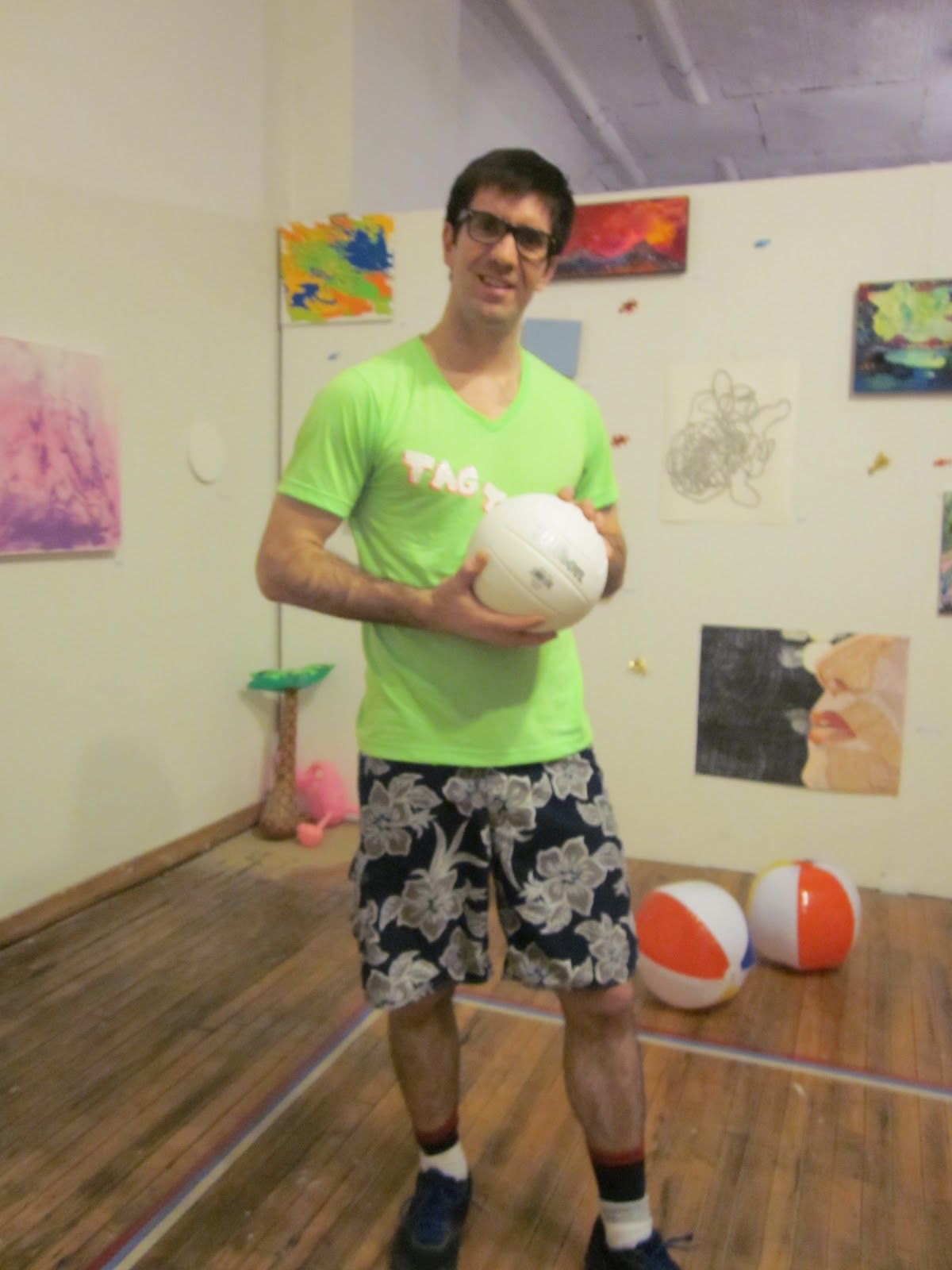
Well, the Chicago weather was typically uncooperative, but we came, we saw, and we played some small-court volleyball (very badly)!

Antena, located on the corner of 18th and S. Laflin, looks from the outside like part of a large warehouse. Inside, though, the space could easily be a comfortable, open-plan apartment. For the purpose of "Short Court", though, as you can see above, it was turned into a gallery-cum-volleyball court.

Alberto Aguilar, standing with his work "Boliche Che-Che"
The first thing you can't help but notice about Antena is its low-key, DIY vibe. This is not the tails-and-caviar affair that we so often see on the television. The artists and visitors who attended "Short Court" were wildly diverse and an incredible amount of fun.


Jake Myers, founder of Octagon gallery, plays some volleyball


There was Alberto Aguilar, whose wood and latex paint creation was one part wall art, one part ball and hoop game that takes its inspiration from tether-ball and the Spanish ball-in-cup game, boliche.


There was Jake Myers, who runs Octagon art gallery and is part of Tag Team, a two-man operation that curated "Short Court". Myers did not have any art featured in the evening's show, but he was all energy nevertheless, encouraging visitors to try their hand at volleyball and discussing the state of the art community in Chicago (interviews with both of these fine gentlemen to follow).


"Into the Woods" by Nicole Northway
"A Thousand Hungry Flowers" by Angeline Evans
The art featured around the studio came in a variety of media. Some of the art used more traditional elements and subject matter.  


And then there were the ones which required you to take a second glance!


We were unable to stay for the entire event, unfortunately, as the inclement weather was only getting more unpleasant, but we really enjoyed the time we spent there, and look forward to getting to know some of these awesome local artists better!

For information about future gallery openings and other events with local artists, check out Art Pilsen for listings, or follow @artpilsen on Twitter!

Katherine H.

Friday, February 10, 2012

Art meets fashion

From kilts to pink flamingos, "Short Court: Tropical Aesthetics" wasn't short on sartorial inspirations.
- Irish S.

Tonight! "Short Court: Tropical Aesthletics" At Antena

As part of the ongoing project to highlight the art community in Pilsen, we will be heading out to a gallery opening this evening. "Short Court: Tropical Aesthletics" is having its opening night at Antena studio in Pilsen! For those of you who are interested in attending, you can find more information here at Art Pilsen (seventh entry down!) and get a full list of the artists being showcased here at Antena's website.


The theme of this show is apparently beach, beach, beach! Who doesn't love the idea of the tropics, especially right now with the weather as gloomy as it is? According to Miguel Cortez, owner of Antena, "Short Court: Tropical Aesthletics" is going to be a sporting event and an art show all in one!

The gallery opens at 6pm and the opening will last until 10pm. Among other things guests will be able to do, there will be a chance to challenge some professional volleyball players (yep, inside the gallery!) to a game, sample some delicious tropical drinks, and take in the art showcased by Chicago artists. I am told there will even be sand!


Project Pilsen will be speaking with some of the artists, taking pictures, and hopefully (fingers crossed that technology is on our side) live-tweeting the event through our Twitter @projectpilsen. Keep an eye on this blog for a full review of "Short Court: Tropical Aesthletics"'s opening night later on.

Cheers!


Katherine H.