Showing posts with label Week Three. Show all posts

Monday, February 27, 2012

Artist snapshot: Jorge G. Zavala (Part 1 of 2)


Jorge G. Zavala
For Jorge G. Zavala, 25, human rights development is a full-time occupation, while art is a part-time hobby. But during his recent exhibit at Al Teatro Ristorante, these two passions collide.
The DePaul alumni takes a moment to discuss a trip to Asia that shaped his work and why he thinks the city’s mainstream art scene should take a few pointers from Pilsen’s more eclectic art scene.

"Kaoli Style"
Are you a full-time artist?
No, I work in human rights and international development so it's definitely a part-time passion.

Which program were you in at DePaul?
I was part of the International Studies program and was additionally active in the Global Asia Studies Program (then referred to as the Asian/Asian American Studies program) as well as Japanese Studies.

Did you formally train as an artist?
Never. I began my life as an artist at the age of five when I played with crayons and I developed that into comic strips and eventually into portraits and landscapes in graphite, pencil, and acrylic paint.

What made you realize you wanted to become an artist?
I've always had a passion for people and my surroundings. I love being creative and feel that through art I can express thoughts, concepts, and ideas I couldn't otherwise through spoken word. Being an artist grants me the opportunity to create something interesting (I hope!) that makes people think and question what they know about a certain topic or idea.

Who’s your all-time favorite artist and why?
That's a tough one. I would have to say my favorite artist is Paul Gauguin. His use of color, portraits and symbolism really impress me every time I look at them. Particularly, I’m a huge fan of portraits and capturing the essence of a person through the stare and the vitality of “the look” that one has. I love doing that with my own work and I see it in Gauguin’s work quite regularly, specifically in his series of French Polynesian work.

How would you describe your style?
Simple and fresh. I make portraits – I draw people. I have them look at me, so that they’re looking at you, the audience, when the piece is complete. I strive to make sure my subject is thinking about something meaningful, something deep in order to convey a serious yet passionate look. I'm not a fan of making things overly ornate. Instead, I like to follow Japanese aesthetics: simple is more.

(Continued in Part 2)

- Irish 

Friday, February 24, 2012

Art in Schools Part 2 of 2

After years of pushing to improve their standardized test scores drastically reduced the time spent on art classes, elementary schools are once again trying to bring those subjects back up to strength. Unfortunately, the grim economy has made it difficult to find the funding to hire new instructors, create new spaces for art classrooms, or provide sufficient supplies.

This is where the art community has stepped in to fill the gap.

Local nonprofits, museums, and community centers are partnering with schools to provide in-school instruction and after-school programs that provide art education students would otherwise not be able to receive.

In Chicago, there is extra emphasis not just on the importance of teaching children about art, but ensuring that they all have access to it, regardless of age or socioeconomic status. Organizations like Prosarts Studio, Marwen, the South Chicago Art Center and Gallery 37 provide space, materials, and classes for children and youth at low or no cost.

One organization in particular has taken the mission of providing quality art education to youth too heart. 


A girl works on part of a mural | photo courtesy of Yollocalli
Yollocalli Arts Reach, a youth art initiative associated with the National Museum of Mexican Art, began in 1997 with the vision to provide “equal access to communal, artistic, and cultural resources” to area youth who might not otherwise be able to afford costly extra-curricular art classes.


Yollocalli does not just serve students who want to pursue a career in the arts, either.


“Most of our students just simply enjoy making and learning about art and do not have many opportunities to explore it on their own,” Vanessa Sanchez, Yollocalli’s program director, said in an email. Sanchez said that the students who came in to Yollocalli ended the program feeling confident about their abilities not just to create a work of art, but effectively communicate with each other about their work, art in history, and their future goals.


“Our young people are given the space to create art based on their own stories and lifestyles,” Sanchez added. “We focus on giving the youth the tools necessary 'to realize their own vision'.”


Making clay art for animation | photo courtesy of Yollocalli
In 2009, Yollocalli was awarded the National Arts and Humanities Youth Program Award, recognizing the organization for its dedication to the young people in the community.


Yollocalli is not alone in Chicago. There are many schools, organizations and groups tapping into the city’s vibrant art culture to bring art and youth closer together, serving as a reminder that art is as vital a subject as literacy and science to a young person’s education.


Katherine H.

Pilsen Murals: Cooper Academy


OROZCO ACADEMY/COOPER ACADEMY (1991)
Photo courtesy of http://cuip.uchicago.edu
 --Located on 1645 West 18th Place, This elementary school is named after a Latino realist painter, Jose Clemente Orozco.
--Since 1991, art teacher Francisco Mendoza has worked with students to cover the building facade with glass tile work.  The mosaic portraits include political leaders like Cesar Chavez, artists Frida Kahlo, and muralists like Diego Rivera, David Siquieros and Jose Orozco.
--Some panels also depict religious sentiment--by displaying Aztec Sun and Moon gods, and devotion to international events like the Olympic Games.
-Monica M.

Thursday, February 23, 2012

Art in Schools: Part 1 of 2


If you grew up in the 1990’s or earlier, chances are you took an art class as part of your elementary school curriculum. You may have dabbled with water colors, lamented covering your school uniform in oil pastels or—if you were lucky—got to spend a few coveted minutes on the oh so awesome pottery wheel. For many kids, art was a normal part of the school day, allotted as much time as science, language arts, or math.

Today, though, art’s place in school curriculums is sliding lower and lower on the priority scale.  Over the last two decades, the emphasis on standardized tests as benchmarks for success (and federal funding) has fostered schools and classrooms that focus on math and literacy with laser-like intensity, while subjects like art and music quietly languish to the back burner.

But far from being an “elective” subject that children don’t really need, research has proven time and again that exposing children to the arts in the classroom helps them develop critical life skills.

A 2007 study “Studio Thinking: The Real Benefits of Visual Arts Education” pointed out skills which were important not just for art, but other fields of study as well. Skills like the ability to develop and execute an idea and the ability to learn from—and move past—mistakes, were things which art classes taught students. The old adage “think outside the box” is learned in the art studio, where children are taught to envision something on a blank page or a shapeless lump of clay.

This, the study suggested, could be carried over to science, where students could be asked to create a hypothesis for an experiment and then try to achieve that outcome; or to history, where students could apply their imaginations to understanding events of the past, and possibilities of the future.

Equally importantly, though, are the mental and emotional development benefits of art. Students are taught patience, persistence, and how to connect with each other and the world around them on a deeper emotional level.

So what are schools doing to re-introduce the arts to the classroom? As it turns out, quite a bit. Schools are partnering with organizations and tapping into their local art communities to reestablish arts programs both in school and after school. Chicago, with its vibrant art ethos, is one of the cities reclaiming art for its schools.

Check Out Part 2 for the steps organizations are taking to bring art education to children and youth in Chicago.

Katherine H.

Guest Blogger: Artist Kate Bowen

In the midst of gearing up for Almost Always Getting it Right, artist Kate Bowen took a moment to write a guest blog post inviting everyone to her exhibition on Sunday, February 26th. 


I am pleased to announce an exhibition of my new work Almost Always Getting it Right at ACRE Projects.  Please join me for the opening this Sunday, February, 26th from 4-8pm.  There will be additional gallery hours Monday February 27th from 12-4pm.
Set against a backdrop of a rural town surrounded by mountains, this exhibition is centered on an obsessive desire for physical perfection and the potential for such perfection to frustrate entropy and provide relief.  My work explores common language used to construct a narrative as a method for expressing desire, understanding failure and coping with loss.  In Almost Always Getting it Right I use still and moving images to focus on themes of beauty, repetition and impossibility.
Guest Blogger, Kate Bowen


For more information on Bowen & her art work, check out: katembowen.com
Amanda B. 

Pilsen Murals: "Wall of Hope"


 Next up...a vivid mural on the corner of 19th and Loomis in Pilsen...

Photo courtesy of madaboutthemural.wordpress.com
--Displayed on the brick facing of the San Jose Obrero Mission, a Latino nonprofit wellness shelter, lies an  image entitled “Wall of Hope”. Though the project was formally headed by artist JesĆŗs “Chucho” Rodriguez... members from the Yollocalli Arts Reach also contributed to the brilliant frieze.
--Yollocalli Arts Reach, is an initiative of the National Museum of Mexican Art (located in the heart of Pilsen), generated to promote urban youth outreach.  The program works with emerging young artists to create innovative forms of artistic expression.
--Work created by the Yollocalli artists is featured all over the Chicago area....many building sites utilize artistic murals to depict social, racial, and political issues in the community.
-Monica M.

Wednesday, February 22, 2012

Catching up with Alex Cohen (Part 2 of 2)


(Continued from Part 1)
Where do you often find ideas or inspiration for your work?
Listening to music, walking around my school or the city, skateboarding with friends or at night when I'm unable to sleep. All the moments in life that seem exciting. Sometimes, the sky is a weird blue and it bounces off the buildings when I'm crossing the Monroe or Jackson Street Bridge by the Art Institute. That tweaks me out and excites me, too.

What other types of media do you hope to experiment with?
Hmm... I don't know right now. I would like to be a better craftsmen. I would like to work more with wood and also learn how to use saws and tools. But I'm very much intimidated by all those things. I think I like cardboard canvas and paper because I can use them easily. Ceramics is also rad - I love the
process. Maybe music would be the correct answer, though. I would really like to be a rapper.


Can you describe the concept behind your installations?
Fun, really. I would just like to create an area where someone could go to have fun and feel nice. I think of children's hospitals.


What do you think of the art scene in Chicago as a whole?
I think it's actually a really fun city to make art in. There are alot of great artists. The imagists are amazing. The graffiti is sick. There are a lot of great things happening. Hopefully they'll let buster in, aha. I also have a show at Co-prosperity on March 3 and I have some
 stuff in the Chicago Zine Fest. I will be releasing a new Zine for parkingblockpublishing.


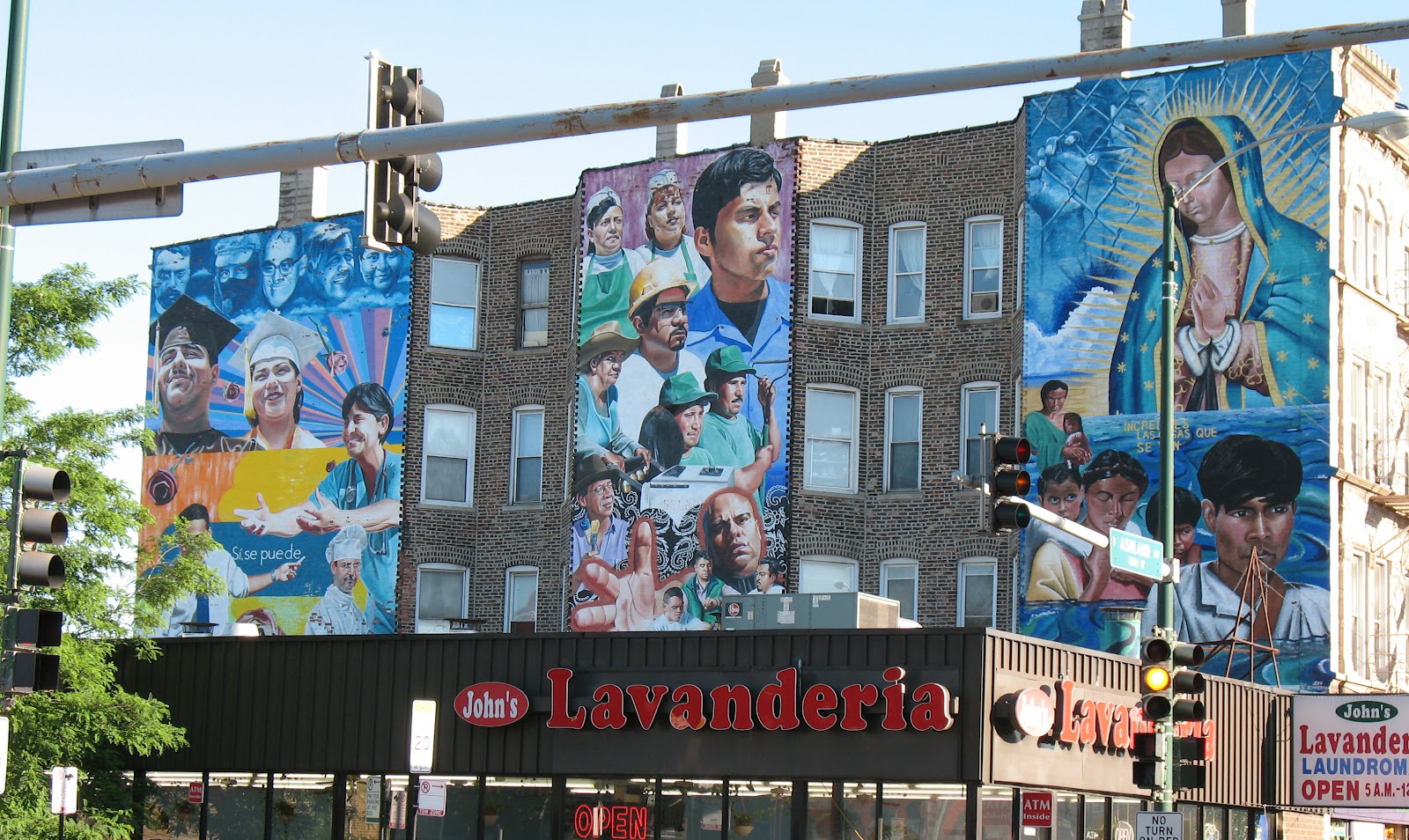
Pilsen Murals: " “IncreĆ­bles Las Cosas Q’ Se Ven”

Over the years, the people of Pilsen have nurtured a festive art community... that's a given....BUT... among the many galleries and museums scattered throughout the community, are other public forms of expression--MURALS.


Over the next few weeks, we will highlight some of these urban art billboards, the intriguing artists that created them, and their importance in this rich neighborhood.


First up... drum roll please... rat-a-tat-tat...


 “IncreĆ­bles Las Cosas Q’ Se Ven”--"Oh the things you'll see"
In 2001, Jeff Zimmermann, a native artist from Chicago, presented a three-panel building mural on the corner of 19th and Ashland in Pilsen. Like many of Zimmermann's pieces, the mural incorporates politics with community action, neighborhood personas, and religion. 


Photo courtesy of madaboutthemural.wordpress.com


Panel One-devoted to image of Our Lady of Guadalupe
Panel Two-features the working members of the community
Panel Three-displays political figures like Cesar Chavez hovering over the heads of students and successful career,minded individuals. 


This is just one of the many attractions that Pilsen has to offer, so if you haven't already...check it out...very large, very colorful, very cool.
-Monica M.

Artist Snapshot: Maggie Haas (Part 1 of 2)

Based in San Francisco, artist Maggie Haas is looking forward to a weekend in Chicago for Auntie Em's Mobile Home, an exhibition showcasing her new works that capture the "uneasiness and fragility of built environments and domestic space." 

Teaming up with photographer TJ Proechel and curator Paul Hopkins, the exhibition will take place on Saturday, February 25th at SLOW, 2153 W 21st Street, Chicago 60608. 


Artist Maggie Haas

The Pilsen Project caught up with Haas to discuss her art and the upcoming exhibition. 

When did you first get involved with the art world? 

I was very lucky to have enjoyed painting as a kid and to never have been discouraged.  I grew up in a community where a lot of my friends' parents were craftspeople. In that way, it's like it's something I just fell into.  But I studied at Carnegie Mellon University in Pittsburgh and that experience was what put me on the path I'm on.  I loved having peers who were experimenting with things they felt deeply about, succeeding and failing and trying again, and I loved the honesty of critique.  But most of all I like making things with my hands.  None of that has changed, even as I grow older and my interests evolve.  

What is your preferred medium? 

Nothing beats the directness of putting a brush to paper, but I use a lot of different materials.  What they have in common is that for the most part they're materials most of us have some direct, tactile experience of using.  Wood, pins, pencil, drywall and paint are all built, quite literally, into our daily lives.  I'm interested in objects and materials that can draw on that physical familiarly, even if they echo it in strange ways.
Young Ones - Haas, 2009
How would you describe your work? 

I hope it feels familiar.  A lot of the forms I draw and sculpt are rooted in common building and craft materials and techniques, from things that feel super-handmade, like quilts, to industrial things like wood pallets.  Either way, I'm most interested in how they become something more what they are intended to be: the formalities of lumber sizes, the way a textile pattern, seen in the right way, looks like an Agnes Martin painting or a blueprint or both.

Installation View - Haas, 2010

Amanda B.

Tuesday, February 21, 2012

Catching up with Alex Cohen (Part 1 of 2)


Alex Cohen: "Art kept me out of getting into trouble."

He may only be 22 years old but Alex Cohen appears to be wiser beyond his years. This Chicago native creates pieces that are as bold and colorful as his style. We first spotted this young up-and-comer at Antena Gallery's ‘Short Court’ but we caught up with Cohen to talk more about his work, upcoming projects and why art has helped to completely transform his life.

What made you realize you wanted to become an artist?
After I dropped out of high school I had a lot of free time on my hands. I would frequent museums and ride the trains alone for hours and just walk around downtown listening to music. I would see things that interested me and I guess I just tried to replicate that in my free time. I also used to make art with my mom when I was younger and it's also just in the culture of skateboarding. A lot of the older people I looked up to made art as well. It was always there. It was really just after dropping out of high school that I really started exploring art again. It kept me out of getting in trouble.


Who’s your all-time favorite artist and why?
I have a few favorite artists. I'll give you three: Matisse, Bob Thompson, and Chris Johanson. These artists really speak to me through their inventiveness of material and process. They all also use bright colors, which is something I do in my practice. Color is pure.


How would you describe your style?
Fun. I hope that's what people get out of it - that life is fun and exciting. Life isn't a sad long miserable process it's actually really fun you just have to surround yourself with the right people to enjoy its full “funness”! But yeah when I create a work I try to think how fun I can make it look and feel.

(to be continued) - Irish S

Chicago Youth Art Programs


As part of a larger article on about youth art programs in Chicago (up later this week), we have been researching various institutions and non-profit organizations that are offering art programs for children and youth here in Chicago. Some of the programs are very nifty, so we decided to compile a list! Check out their websites for plenty of excellent information.

ProsArts Studio--located in the Pilsen area, this organization has been providing arts-in-education and community building services for 30 years. They work in neighborhood schools as well as run programs outside the classroom.

Yollocalli Arts Reach--another Pilsen-area organization, affiliated with the National Museum of Mexican Art, Yollocalli is a youth-oriented outreach which combines creativity, heritage, and "urban art practices" to help children and young adults become engaged and active within their communities.

Marwen--located in the River North neighborhood, Marwen provides visual arts education for Chicago youth, as well as college and career programs such as college counseling, arts and study field trips,  and scholarship and internship opportunities.

The South Chicago Art Center--located in South Chicago, this free center provides in-school and after-school programs for children and teens, an award-winning Artist's Garden (created and  tended by the children in the program), and field trips to art museums, galleries, and other spaces.

Art Institute of Chicago--The list would not be complete without mentioning the Art Institute's contribution to providing art programs for kids and teens. From studio workshops, to a Museology program, to the Teen Lab, there is something for everyone.
These are just a handful of the many great youth arts programs around the city.
Katherine H.